Research into adding value to crops is driven by consumer demands and societal needs. In the following two cases, PSI researchers genetically engineer sorghum to meet the demand for sustainable biofuels, and camelina for a naturally occurring red pigment for food, nutraceuticals, and cosmetics.
Development of vegetative oil sorghum: from lab to field
Sorghum is a high-yielding, environmentally resilient crop used mostly as a grain. PSI faculty Edgar Cahoon and Chi Zhang, with a team of collaborators as far away as Ukraine, worked to develop sorghum that could also be used as a biomass feedstock.
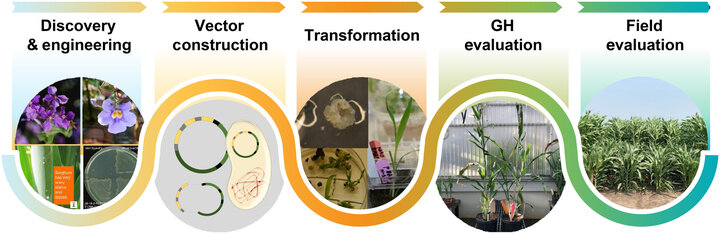
They successfully engineered the Ramada genotype of sorghum to accumulate energy dense triacylglycerols (TAG or vegetable oils) in stems and leaves. The top yielding constructs contained five oil transgenes to enhance oil production, storage, and protection. In the greenhouse, they found 36-fold (leaves) and 49-fold (stems) increases relative to wild plants. In the field, the results were even more impressive: 78-fold (leaves) and 58-fold (stems) increases in the top performing event. This demonstrates a successful approach to developing sorghum that can produce high amounts of vegetable oil, a potential new source for biofuels like sustainable aviation fuel.
Read the article in Plant Biotechnology Journal.
Oilseed‐based metabolic engineering of astaxanthin and related ketocarotenoids using a plant‐derived pathway: Lab‐to‐field‐to‐application
Astaxanthin, a ketocarotenoid with bright red color, is in high demand by aquaculture producers of shrimp, salmon, and trout, as a red food coloring, and as a potent antioxidant in nutraceutical and cosmetic products. PSI Director Edgar Cahoon and his lab have metabolically engineered Camelina sativa, an oilseed crop, to produce astaxanthin.

They transferred genes from Adonis aestivalis, a plant with a bright red flower, and genes from other plants to the camelina. In field trials conducted in the US and UK, the engineered camelina nearly completely converted b-carotene to ketocarotenoids, which were primarily astaxanthin. Their work demonstrates that genetically engineering oilseed crops with plant-derived genes is a viable method for producing astaxanthin, a valuable red pigment and powerful antioxidant.
Read the article in Plant Biotechnology Journal.