PSI faculty and their labs investigate aspects of nitrogen management for precision agriculture. Rather than predicting a crop’s nitrogen needs and applying fertilizer based on predictions, precision agriculture tools monitor aspects of crop health and nitrogen needs and respond to those findings. This can lower the amount of fertilizer applied, saving farmers money and limiting the impact of excess nitrogen on the environment. In the following two publications, PSI faculty and their teams go above and below ground to investigate.
Nitrogen input differentially shapes the rhizosphere microbiome diversity and composition across diverse maize lines
PSI faculty Daniel Schachtman and Jinliang Yang and their teams set out to fill a gap in knowledge about how nitrogen input affects the rhizosphere—communities of microbes adjacent to a plant’s root system that play a vital role in plant health, including defense against stress and disease.
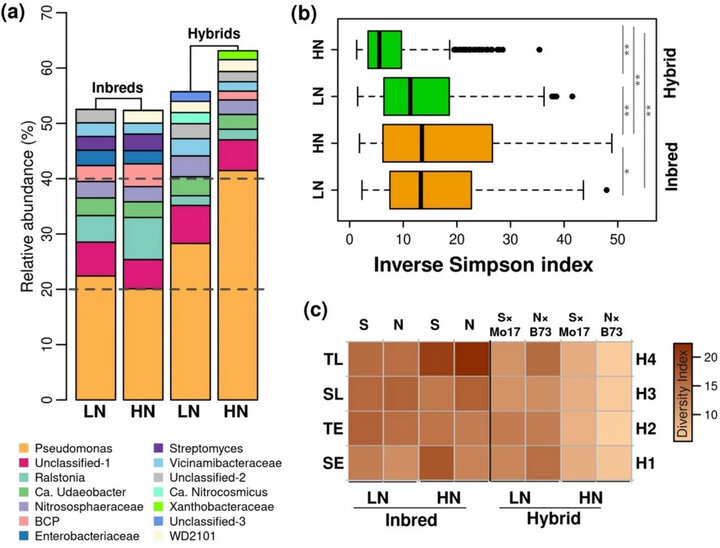
They planted more than 500 maize inbred lines and hybrids at a University of Nebraska–Lincoln facility, grouping them by stalk stiffness, flowering time, and height, then further dividing them into unfertilized and fertilized blocks. They collected rhizosphere samples eight weeks after planting, then extracted and sequenced DNA from those samples to learn how nitrogen application affects the rhizosphere. What they found could potentially guide further research on engineering microbial communities for better nitrogen management in crops.
Read the article in Biology and Fertility of Soils.
Devising optimized maize nitrogen stress indices in complex field conditions from UAV hyperspectral imagery
Using nitrogen (N) efficiently is an important part of addressing agriculture’s grand challenge of increasing food production while minimizing harm to the environment. Assessing a crop’s nitrogen needs can be done using a number of variables to arrive at the Nitrogen Sufficiency Index (NSI), an important nitrogen stress indicator. However, traditional NSI calculations leave out other yield limiting factors such as soil water variability. PSI researcher Yufeng Ge and his colleagues compared these variables and added three estimated from hyperspectral images taken by unmanned aerial vehicles.
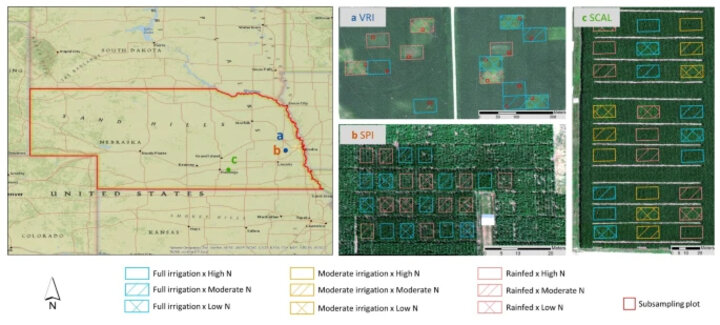
They studied three University of Nebraska–Lincoln experimental maize fields with different environmental conditions and coupled water and N treatments. They found that, when leaf-level and ground sampling measurements are impractical, aerial based measurements can be a viable alternative in calculating NSI, potentially guiding future on-farm N management.
Read the article in Precision Agriculture.